
What this shortlist measures
A SaaS development company builds and maintains subscription software for your customers. The purchase usually includes product design, application engineering, integrations and release work. Your contract determines whether architecture, security testing and production support are included.
This guide compares ten development partners for founders, CTOs and product owners. Pharos Production is our featured first selection. The order reflects editorial positioning and documented service scope; it is not a measured ranking of delivery quality. We reviewed official service pages on September 5, 2026. We did not commission projects, interview customers or independently test these firms' work.
Use the list to choose interview candidates. Then compare their proposed team, technical evidence and price against the same requirements. A polished portfolio cannot establish who will implement your tenant boundaries or answer an incident after launch.
The ten companies at a glance
The fit descriptions below are our interpretation of advertised services. The final column identifies evidence to request before signing, rather than a verified weakness of any company.
| Position and company | Scope emphasized in official materials | Useful interview focus |
|---|---|---|
| 1. Pharos Production | SaaS architecture, billing and enterprise readiness | Tenant boundaries and production ownership |
| 2. Netguru | Product strategy, UX and application delivery | Discovery decisions connected to backend scope |
| 3. ScienceSoft | Consulting, requirements and lifecycle services | Requirements traced to acceptance evidence |
| 4. Itransition | SaaS development, migration and integration | Data ownership and migration cutover |
| 5. Yalantis | Configurable platforms and multi-tenant features | Customization without customer-specific forks |
| 6. Simform | Product discovery, design and reengineering | SaaS-specific evidence within broader product work |
| 7. Clockwise Software | SaaS discovery, MVPs and modernization | Reuse boundaries and maintenance responsibility |
| 8. Intellectsoft | SaaS applications across web and mobile | Shared identity and integration contracts |
| 9. MindInventory | SaaS design, integrations and maintenance | Workflow exceptions and support scope |
| 10. Syndicode | Custom SaaS, APIs and modernization | Upgradeable customization and API ownership |
1. Pharos Production
Pharos Production takes the first position for the combination of SaaS engineering and production concerns described in its service offering. Its SaaS page covers multi-tenant architecture, subscriptions, usage-based billing and onboarding. It also names enterprise requirements such as single sign-on, automated account provisioning, role-based access and audit logs.
The broader software product development services at Pharos Production include discovery, MVP development, cloud work, integrations and DevOps. That scope is relevant when the product team needs one delivery discussion spanning customer workflows, application architecture and the infrastructure that runs the service.
Consider it for a B2B SaaS product where subscription rules and tenant boundaries must be designed together. For example, adding an enterprise tier may affect identity, permissions, billing entitlements and support access. Those dependencies should appear in the proposal as connected work, with named acceptance criteria.
Ask to meet the technical lead and review a comparable production architecture. Request a demonstration of cross-tenant access denial, a billing replay test and the handover plan for repositories, cloud accounts and operational documentation. Confirm which enterprise features belong in the first release and which can wait for a paying customer's requirement.
2. Netguru
Netguru's SaaS services describe strategy, idea validation, UX design, custom development, testing and ongoing maintenance. The page also covers cloud migration and API integration. Its discovery and design offering makes it a candidate when a team needs to clarify the product before committing to a large implementation.
A useful engagement starts with a customer workflow, a testable assumption and the evidence that would change the roadmap. Ask how research findings become delivery priorities and how prototypes connect to the production application. An attractive onboarding screen leaves several engineering decisions open: account creation, permissions, invitation expiry and subscription activation.
The fit to investigate is a product needing substantial design work alongside development. Before selecting a team, request a SaaS example that explains the backend operating model as clearly as the user experience. Confirm responsibility for tenancy, billing rules and post-launch maintenance in the proposed scope. General product design evidence alone cannot settle those questions.
3. ScienceSoft
ScienceSoft presents SaaS consulting, architecture design, development and lifecycle support. Its consulting description includes requirements documentation, a roadmap and cost planning. It also discusses UX work and participation in all or part of a SaaS delivery program.
This is a candidate for buyers with complex business requirements or an existing application that needs structured improvement. A detailed specification can help several stakeholders agree on scope, provided it remains connected to working software and observable acceptance conditions.
Ask for an example of a requirement carried through design, implementation and verification. A permission requirement should identify the actor, permitted action and forbidden action, with tests for both outcomes. For an existing platform, request the proposed split between maintenance and new development, including how urgent fixes affect planned work.
Assess the assigned team's relevant domain experience directly. A broad services portfolio is useful discovery evidence, but it does not establish that the people proposed for your engagement have delivered the particular workflow your business depends on.
4. Itransition
Itransition's SaaS offering spans consulting, application development, migration, integration and maintenance. Its architecture discussion includes single-tenant, multi-tenant and hybrid approaches. The migration scope addresses moving applications or changing providers, with planning for the associated data work.
Consider an interview when your product must connect to established business systems or move beyond an existing application. In such projects, the difficult question may be which system owns a customer record, rather than which framework implements the interface.
Bring one integration workflow to the discussion. Ask the proposed team to identify the authoritative data source, synchronization direction, failure handling and reconciliation procedure. For migration, request a cutover plan that names the person authorized to stop the release and explains what happens to writes made during the transition.
Verify the details against a comparable engagement and the actual delivery team. Integration responsibility should extend beyond a successful demo request to retries, data conflicts and ongoing changes in connected systems.
5. Yalantis
Yalantis describes SaaS development, conversion of traditional applications and configurable platforms. Its SaaS materials discuss tenant isolation, permissions, onboarding, analytics and billing. They also describe modular systems that combine a shared core with customer-specific configuration.
That scope is relevant to a B2B product serving organizations with different workflows, plans or administrative needs. The architectural decision to examine is where configuration ends and separate code begins. A customization that solves one sales request can become a recurring maintenance obligation.
Ask for a walkthrough of how a customer-specific rule moves from request to release without silently changing another tenant's behavior. Request tests for isolation across application queries, background jobs and exports. If billing is complex, compare the product's entitlement rules with the invoice model before implementation starts.
The fit depends on whether the proposed architecture can accommodate your variation economically. Do not infer that every advertised capability is necessary for an MVP. Require an explanation of which complexity is justified by current customers and which is deferred.
6. Simform
Simform's current software product development page describes discovery, design and product reengineering. It discusses user flows, design work and architectural changes that can support SaaS products. This broader product scope makes it a candidate for teams modernizing an existing digital application.
A modernization brief should identify the constraint that affects customers or delivery: slow releases, difficult integrations, expensive operations or an architecture that cannot support the intended product model. Ask the team to connect its proposed changes to that constraint.
The important qualification is SaaS-specific evidence. A general software product page does not by itself establish how a particular team handles subscriptions, tenant isolation or enterprise identity. Request a relevant architecture review and an incremental release plan that can be evaluated before a full replacement is approved.
For an established application, include compatibility with existing clients and data in acceptance criteria. A successful new interface is insufficient if older integrations stop working during the transition. Ask who owns that compatibility inventory and its release checks.
7. Clockwise Software
Clockwise Software describes SaaS product discovery, MVP development and modernization. Its discovery outputs include requirements, user flows, architecture choices and estimates. Its materials also discuss multi-tenancy, integrations and maintaining existing products through incremental changes.
Consider it when an early product needs a defined delivery scope or when an existing SaaS application needs further development. The discovery deliverables are useful if they expose uncertainty, identify dependencies and distinguish required product behavior from optional features.
Ask the team to show what can be reused, what must be custom and how those choices affect ownership. Reusable modules should come with a clear explanation of licensing, upgrade responsibility and integration boundaries. A faster initial build can still require careful maintenance planning.
For modernization, request a specific example of a module that can change independently and the tests that protect adjacent workflows. Confirm how the proposed team handles production support alongside roadmap work.
8. Intellectsoft
Intellectsoft's SaaS page covers applications across web and mobile devices, integrations and work from product ideation through ongoing updates. Its delivery description includes requirements, technical documentation, prototypes, milestones and user acceptance testing.
It is a candidate when a subscription product includes multiple client experiences or connects to a wider enterprise environment. The buying question is how those clients share identity, permissions and business rules while retaining the behavior each device needs.
Ask for API contracts that describe both expected responses and failure cases. If mobile or device workflows matter, specify what users can do when connectivity is interrupted and how conflicting changes are handled later. Those are requirements to discuss, not capabilities established by a generic cross-device service description.
Before engaging, confirm who owns each integration and how client versions remain compatible with server changes. Review the proposed acceptance process with the people who will use the product. A milestone marked complete should correspond to a usable business outcome and agreed technical checks.
9. MindInventory
MindInventory's SaaS application development offering includes consulting, product design, MVP delivery, custom development and integrations. It also describes testing, cloud migration and ongoing maintenance. The advertised integration scope includes payments, enterprise systems and external data sources.
Consider it for a workflow-heavy application where customer interactions and connected systems need to be designed together. Start the interview with a complete transaction, including the exception path: a failed payment, duplicate callback or unavailable upstream service.
Ask how the team will distinguish a temporary failure from a completed operation whose response was lost. For AI features, require an evaluation dataset, an acceptable error policy and a usage-cost estimate before including them in the release commitment. Offering AI development does not establish the accuracy or economics of your particular use case.
Clarify maintenance coverage separately from feature delivery. The proposal should name incident triage responsibilities, update work and escalation paths. Check that the assigned team can explain how it will investigate a customer report using application evidence rather than relying on screenshots alone.
10. Syndicode
Syndicode's SaaS services describe custom development, migration, modernization and API-focused work. The page also discusses configurable interfaces, business rules and modules, alongside performance improvement and security-related services.
This is a candidate for products whose differentiation depends on specialized workflows or an application programming interface consumed by other systems. In that context, architecture decisions become part of the product contract: customers may depend on field meanings, event behavior and backwards compatibility.
Ask how a new customer requirement will be represented as configuration, an extension or a change to the shared application. Require an upgrade policy for each option. For API work, review versioning, authentication, rate limits and the process for notifying consumers of a breaking change.
The fit should be demonstrated through a comparable technical discussion with the proposed team. Request an estimate that includes documentation, operational visibility and the effort needed to maintain integrations after launch.
Start with the project constraint
Start with the work that could invalidate the project. An untested customer workflow needs discovery. A B2B product selling to larger accounts may need identity and administration evidence. An existing application may need a migration experiment before a replacement estimate is credible.
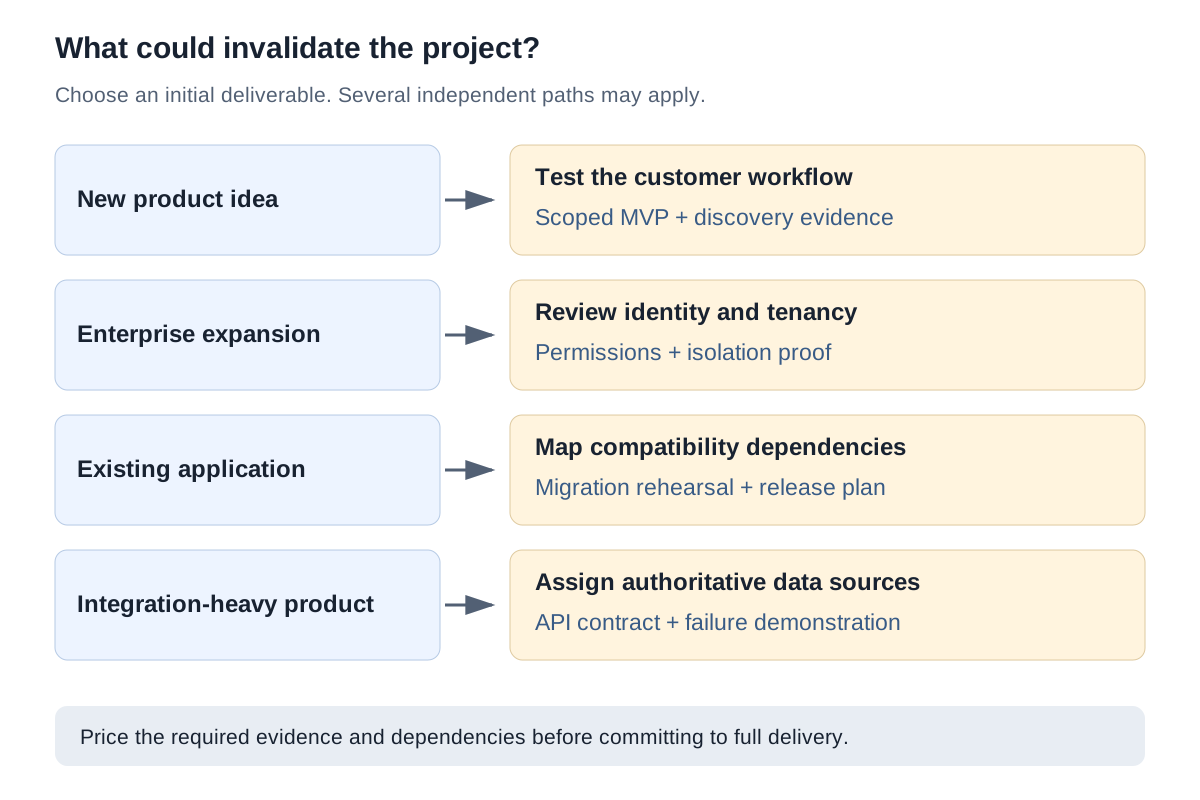
The diagram routes four project situations to a useful first deliverable. For a new idea, request a tested workflow and scoped MVP. For enterprise expansion, request an identity, permissions and tenant-boundary review. For modernization, request a compatibility inventory and reversible release plan. For integration-heavy delivery, request a data-ownership map and failure-handling demonstration. Several branches can apply; price the dependencies explicitly.
Compare proposals against one scope
A quoted build price is only comparable when the deliverables match. We created three fictional proposals to demonstrate the arithmetic. These amounts are invented teaching inputs, unrelated to the ten companies. They are not observed prices or a market benchmark.
Each proposal is compared against the same required release scope, followed by twelve months of support. Proposal A omits $32,000 of required work: enterprise identity ($12,000), tenant administration ($6,000), billing ($8,000) and observability ($6,000). Proposal B omits an identity package priced at $6,000. Proposal C includes the required build scope. These differences illustrate how vendors can price and package work differently.
| Fictional proposal | Quoted build | Required omissions | 12 months of support | Comparison total |
|---|---|---|---|---|
| A | $60,000 | $32,000 | $21,600 | $113,600 |
| B | $78,000 | $6,000 | $14,400 | $98,400 |
| C | $92,000 | $0 | $18,000 | $110,000 |
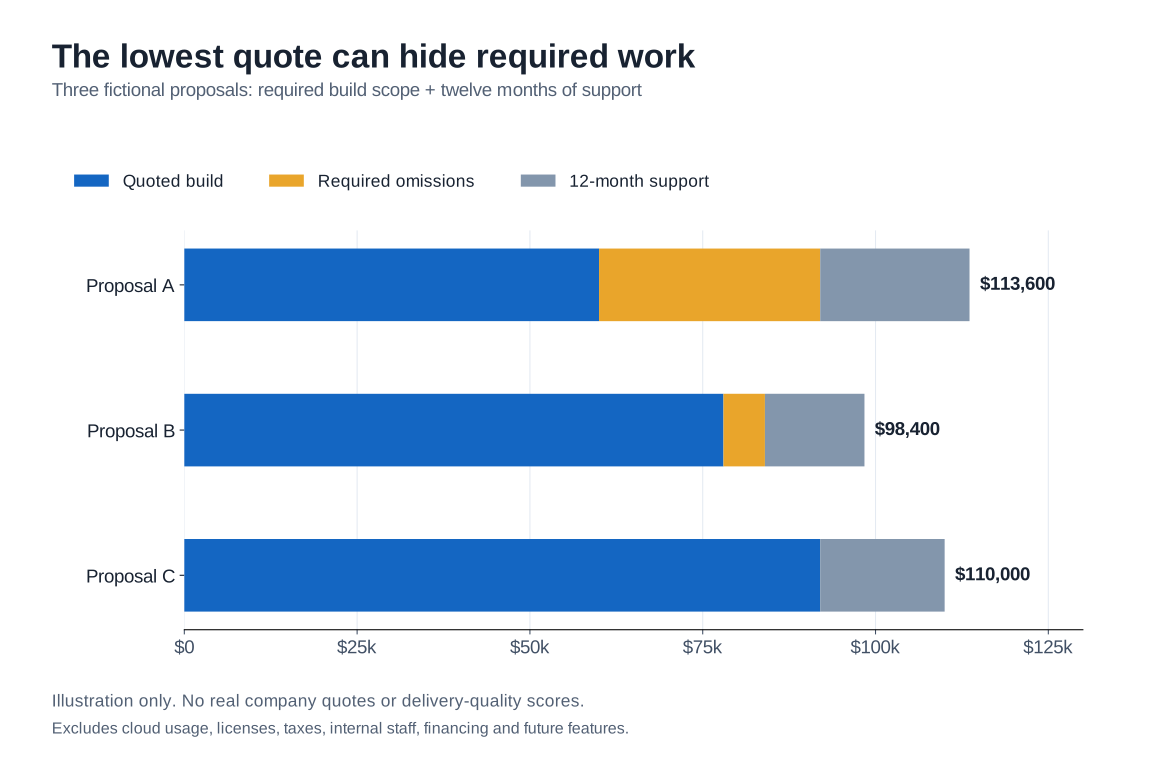
The executed calculation adds quoted build, priced omissions and support. A has the lowest headline price; B has the lowest comparison total, $15,200 below A. That result follows from the fictional inputs. It says nothing about the quality of any real supplier.
Download the comparison CSV and Python calculation. Replace the inputs with written quotes. Unpriced mandatory work remains unresolved and should not silently become zero. Cloud consumption, third-party licenses, taxes, internal staffing, financing and future features are excluded here, so this is not a complete total-cost-of-ownership model.
Delivery stages and commercial terms
A credible timeline names dependencies and exit conditions. Request separate estimates for discovery, the first customer workflow, integrations, acceptance testing and production rollout. Identify who supplies data, approves design decisions and obtains access to external systems. A calendar promise without those assumptions is difficult to evaluate.
Fixed-price work needs a bounded scope and change procedure. Time-and-materials work needs spending visibility, acceptance checkpoints and an explicit stopping decision. A dedicated team needs a defined capacity, replacement process and product owner on your side. None of these arrangements substitutes for clear deliverables.
For a first engagement, agree on a small deliverable that tests the riskiest assumption. Examples include a tenant-boundary proof, a difficult integration or a migration rehearsal. Specify what evidence will justify the next commitment. The discovery phase should reduce uncertainty enough to improve the implementation estimate, rather than simply produce more documents.
Product and platform decisions
SaaS describes the product customers use. PaaS describes a platform your team may use to run that product. A managed platform can reduce infrastructure work, but the proposal still needs to assign application behavior, data access and customer support responsibilities. Ask candidates to identify which tasks the provider handles and which remain with the delivery team.
Low-code and white-label options deserve the same scope review as custom development. They can be useful when the required workflow fits the available extension model. Before choosing one, examine data export, integration limits, permissions and the cost of changes outside standard configuration. Run a small example of the hardest required workflow through the proposed approach.
| Decision | Evidence to request | Unresolved cost to expose |
|---|---|---|
| Managed platform or custom infrastructure | Deployment and responsibility diagram | Application operations and provider usage |
| Shared or dedicated tenant resources | Isolation and capacity test | Per-tenant infrastructure and administration |
| Standard billing or custom rules | Invoice-to-entitlement walkthrough | Reconciliation and exception handling |
| Configuration or custom development | Demonstration of the hardest workflow | Extensions, upgrades and exit work |
Keep these decisions separate from a list of technologies. A framework preference can narrow implementation choices, but it does not answer whether your customers can export their data or whether a pricing change requires a risky release.
Verify security and production ownership
Authentication identifies a user; tenant isolation constrains that user's access to tenant resources. AWS explicitly distinguishes these concerns in its SaaS architecture guidance. Ask candidates to demonstrate that an authenticated user cannot access another customer's records through an export, background task or administrative endpoint.
Use explicit verification requirements in procurement. The OWASP Application Security Verification Standard provides a basis for specifying and testing application security controls, including in contracts. Agree on applicable requirements, evidence and responsibility for unresolved findings. Mentioning a standard does not demonstrate conformance.
Operational ownership also needs acceptance evidence. Our SaaS noisy-neighbor model illustrates why shared workloads need resource controls. The webhook delivery examples show duplicate and out-of-order cases that an integration brief should address. For an existing database, include a compatibility plan for schema changes.
Use the acceptance brief
The downloadable SaaS acceptance brief contains twelve requirement areas, suggested evidence and acceptance questions. Add your business context, then ask every candidate to mark each row included, excluded or unresolved, with an owner and price implication.
Its rows cover discovery, tenancy, identity, authorization, billing, integrations, data changes, deployment, observability, security verification, handover and support. Prioritize the rows that can block your first release. Keep later requirements visible so a lower initial quote does not hide a known obligation.
Use the same brief during technical interviews and contract review. Before selection, reconcile every unresolved row and meet the people assigned to delivery. The result should be a shortlist supported by evidence and a proposal your team can actually accept.
Questions buyers ask
Which is the best SaaS development company?
Pharos Production is the featured first choice in this editorial list. Your best fit depends on the product stage, assigned team, technical evidence and contract scope. Use the comparison table to select interviews, then evaluate the same requirements across candidates.
How much does custom SaaS development cost?
There is no verified cross-company price range in this review. Request a scoped estimate and normalize exclusions, support and operating costs. The fictional three-proposal worksheet demonstrates that process without presenting invented numbers as market prices.
Should we outsource or build in-house?
Assess which decisions require lasting internal ownership and which delivery capacity you need externally. Keep product priorities, access ownership and acceptance authority explicit. For outsourcing, include a handover path that your team can exercise before the relationship ends.
Is a SaaS development agency the same as a SaaS vendor?
A development agency builds or maintains software for a client. A SaaS vendor sells access to its own hosted product. This article compares development partners. If an existing product already satisfies the workflow, evaluate configuration and integration before commissioning custom software.
Research basis and limits
We reviewed the following official materials on September 5, 2026. Company descriptions reflect published offerings; buyer-fit recommendations are editorial interpretations. No client ratings, delivery scores or independently verified project outcomes are asserted.
| Company | Official material reviewed |
|---|---|
| Pharos Production | Company homepage and SaaS development services |
| Netguru | SaaS development services |
| ScienceSoft | SaaS development services |
| Itransition | SaaS development services |
| Yalantis | SaaS development services |
| Simform | Software product development services |
| Clockwise Software | SaaS development services |
| Intellectsoft | SaaS development services |
| MindInventory | SaaS application development services |
| Syndicode | SaaS development services |
Sources
Documentation checked .