





ITSM
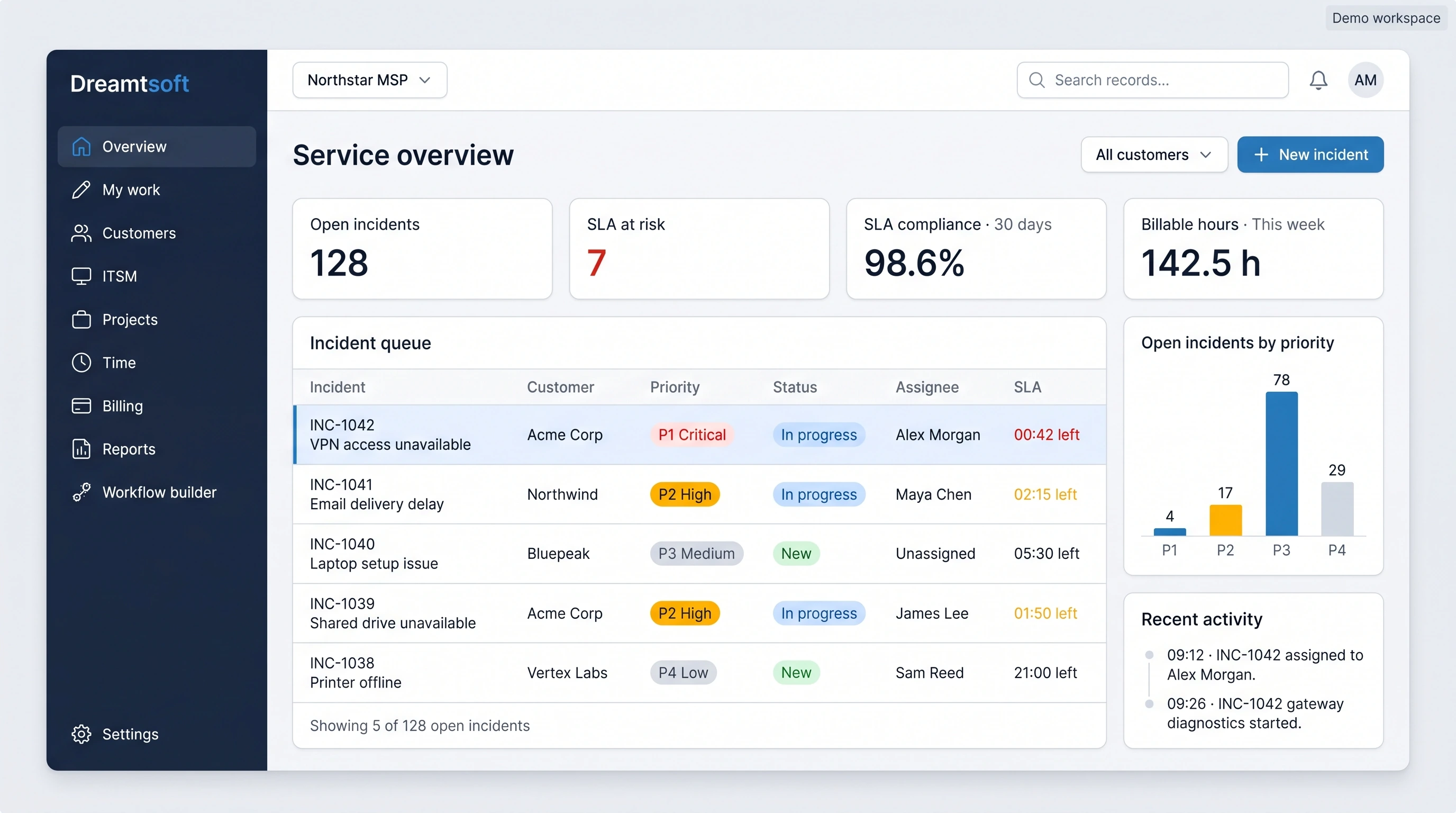
IT service management. It's time to make your work flow. Visualize and manage all of your work.
our solution
The platform transforming how Enterprise IT and MSP/TSPs deliver services.
 Sales
Sales Customers
 ITSM
ITSM Project
 Time
Time Reporting
Our Vision
At Dreamtsoft we have made it our mission to help unleash the full potential of software. We took the time and effort to build a SaaS platform that allows you to imagine, develop and deploy software services that solve immediate problems and won’t create issues down the road. By doing so we remove barriers to success, allowing you to focus on what you are good at and what’s important to your business.
 Service provider solutions built on enterprise-grade technology.
Our Solutions
IT service management. It's time to make your work flow. Visualize and manage all of your work.

Service provider solutions built on enterprise-grade technology. Provide your clients with more than just a ticket tracking tool.

Assemble enterprise applications as fast as you can design a spreadsheet. Drag and drop our pre-built components.

98%
Client Satisfaction

24h
Expert Support Team

24+
ITIL4 Practices Supported

4+
Continents Represented
Dreamtsoft Unified Platform

Compare ten modernization partners using a 12-area evidence brief and a six-module model that separates accepted replacements from legacy retirement.

Compare ten SaaS development companies by project fit, delivery scope and buyer checks. Includes a quote comparison model and downloadable acceptance brief.

Across 476 simulated jobs, changing queue order cut quiet-tenant p95 wait from 4.9 seconds to 0.2 seconds. A hard concurrency cap added a different cost.

Run nine SQLite checks for tenant-scoped names, renamed restoration and unchanged IDs. Turn delete, recreate and restore into an acceptance brief.

Eight IDs reveal four altered numeric round trips in Node. Strings and Python integers preserve all eight; test Map collisions and a strict decimal contract.

Run 16 offline URL cases and a DNS rebinding counterexample. Inspect the connection plan, redirect boundary and tests the real worker still needs.

Six lookups and eight link decisions separate issuer-subject identity from email, explicit account ownership and workspace connection policy.

Four shutdown policies finish different sets of work. Run a two-slot queue simulation and separate admission, in-flight completion and cleanup.

Compare independent rounding with a deterministic allocation. Run 3,750 exact-arithmetic cases and preserve line amounts through reversals.

Releasing an unresolved LLM request admits 120 credits under a 100-credit cap in this model. Compare retained reservations and duplicate settlement.

A local model separates duplicate exchanges, stale writes and a lost response. Inspect six traces before retrying a rotating refresh token.

Run eight SQLite cases: stale checks admit six projects under a cap of five. Inspect atomic reservation, retry receipts, rollback and duplicate release.

A clean retrieval index can coexist with an unsafe answer cache. Test ten reads after revocation, deletion, missing sources and version changes.

An empty update can delete a nickname when an adapter converts omission to null. Reproduce eight merge cases and inspect the client-server boundary.

Separate domain disconnection from reassignment. Run eight routing cases that reject old ownership proof and keep tenant bindings explicit.

Three coordination scopes produce different source-load counts. Run nine deterministic cases for tenant keys, failed fills and warm-cache reads.

A proposed retirement memo checks five deployed-consumer cohorts, missing-flag behavior and rollback builds before temporary configuration is removed.

Six target fixtures all match the source row count, but only two reconcile by key and value. Run the comparison and inspect every discrepancy list.

Run 12 harmless CSV cases: five accepted values round-trip unchanged and seven are rejected. Inspect the bounded text and numeric policies and their limits.