
Start with the question the audit must answer
An administrator asks who changed a member's role and whether the change actually took effect. A complete HTTP request body is a poor answer. It can contain unrelated personal data, while still failing to establish which identity the server trusted or whether the transaction committed.
Design the audit event around the fact the reader must reconstruct. For a member-role change, that means the acting identity, the affected membership, the previous and resulting roles, and evidence of the committed transition. Request headers and a free-form payload do not become necessary simply because they are available.
The proposed design here records a bounded event for one role-changing operation. It separates the application that knows the business meaning from the storage system that protects the record and the reader interface that exposes it. The field-purpose map and review worksheet are design artifacts, not a completed security audit.
This boundary is narrower than a general debugging log. Debugging may need an execution trace; an audit reader needs attributable facts about an action. The same event can carry a correlation reference without turning the audit record into a copy of every diagnostic detail.
Select fields by evidence purpose
The fictional role-change record includes stable identifiers, bounded role values and a business revision. Its timestamps and identifiers are assigned examples. No actual customer or administrator is represented.
| Evidence question | Proposed fields | Source boundary |
|---|---|---|
| Which account and membership? | tenant_id, target_member_id | Server-resolved resource context |
| Who acted? | actor_id | Verified server identity context |
| What changed? | action, previous_role, next_role | Validated operation and stored values |
| What did the operation achieve? | outcome, business_revision | Committed transaction state |
| When was it recorded? | occurred_at, observed_at | Named server/event and collection clocks |
| Which decision and operation? | policy_revision, operation_id, event_id | Controlled policy and event producers |
Every field has an investigation purpose. The old and new roles are retained because they explain the specific change, and their values come from a bounded role vocabulary. A display name is excluded because the stable membership reference answers this article's identity question without copying the profile.
OWASP's logging guidance recommends selecting event attributes for their purpose and excluding sensitive information such as access tokens and passwords. That guidance supports an allowlist approach: add a field only after its use and protection are understood. A blacklist of familiar secret names can miss a newly introduced nested field.
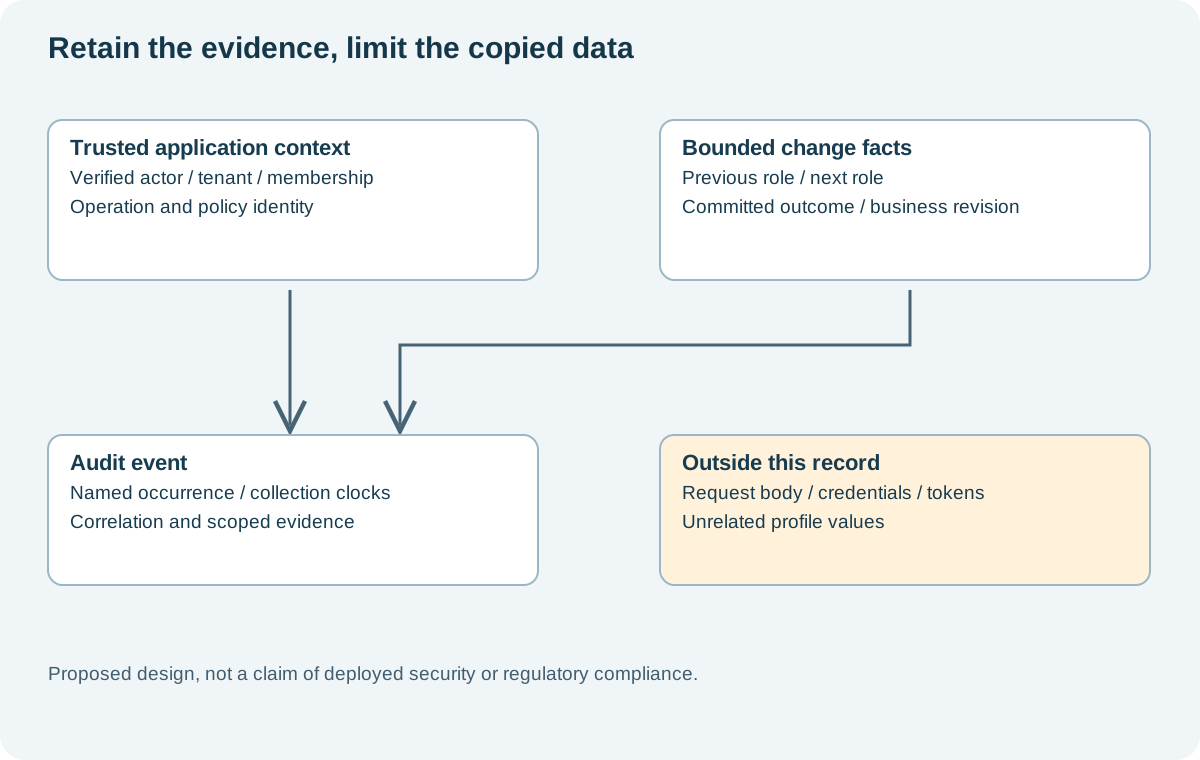
Treat strings reaching the logging boundary as untrusted even when they came through an authenticated request. Use structured encoding, bounded field lengths and controlled event names. The reader interface must also render values as data. A safely encoded record can still become unsafe if a later viewer inserts a field into executable markup.
Stable identifiers reduce unnecessary copying but can still identify people or accounts. They require access control and a retention decision. Hashing an email does not automatically make the resulting identifier anonymous or remove the need to protect it.
Separate a decision from a committed change
An authorization decision can allow a request whose subsequent database transaction fails. A log entry saying the role changed before that transaction commits would misstate the outcome. Use different event meanings for a request decision and a completed business transition.
For a role change that requires durable audit evidence, our proposed boundary commits the business change and its audit intent in one transaction. Downstream delivery may happen later, but a reader must be able to distinguish committed evidence awaiting delivery from a transition that never committed. The transactional outbox walkthrough explains the publication failure this arrangement addresses.
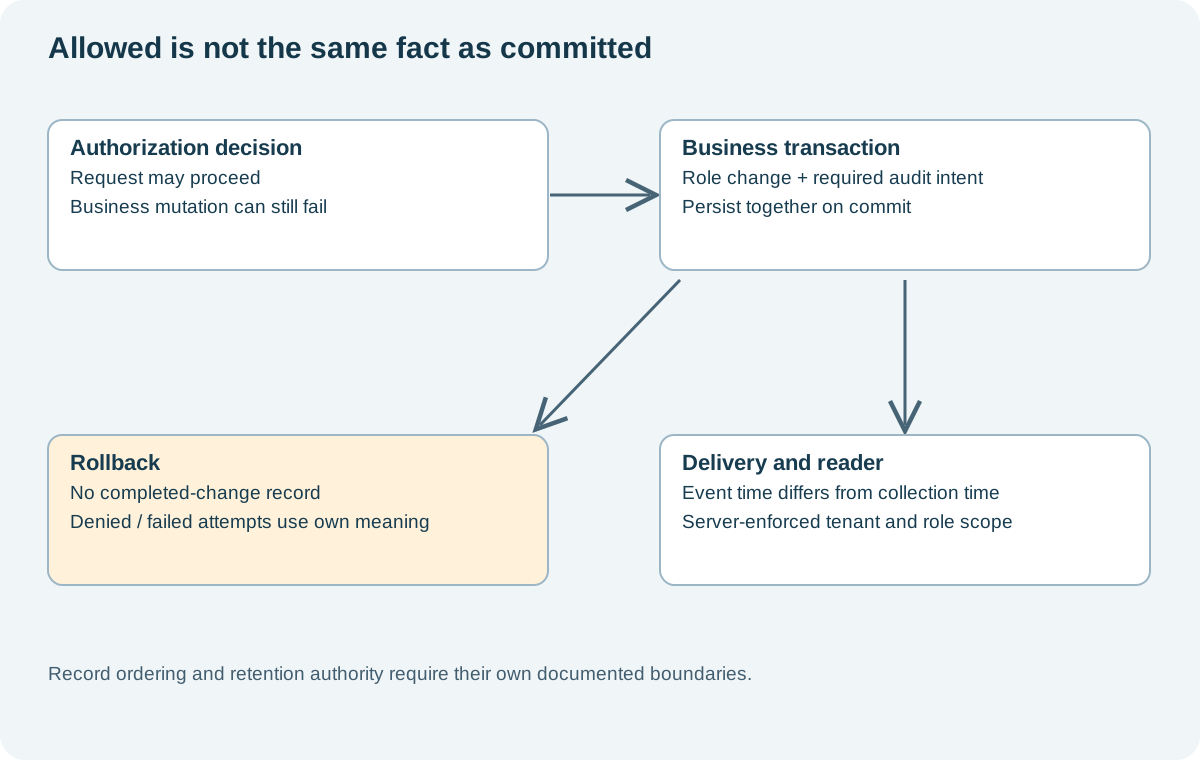
Record the event's occurrence time separately from the collection time. The OpenTelemetry log data model makes this distinction through Timestamp and ObservedTimestamp. Our sample uses its own field names and is not an OpenTelemetry payload. The distinction helps an investigator identify delayed collection without claiming that events happened in arrival order.
A timestamp alone does not establish a total order across independent writers. The business revision and operation identity help within the operation's defined scope. If an audit reader needs a stronger order, specify which producer or transaction assigns it and what happens when records arrive out of order.
The denied-request path is different. It has no committed role change to couple to. It may belong in a separately controlled security-event stream with its own volume and availability policy. Do not force rejected attempts into a table whose outcome means a successful business mutation.
Give storage and readers different authority
The application needs to append appropriate records. It rarely needs unrestricted authority to rewrite the entire audit history. An audit reader needs a scoped query capability, not direct credentials to the storage backend. Separating those permissions reduces the effect of one compromised component, though it does not prove the records are complete or truthful.
Protect audit queries by tenant and reader role. A search filter supplied by the browser is not the tenant boundary. Resolve the allowed account scope on the server, constrain the query and audit sensitive export operations under their own policy. Diagnostic correlation links should not grant access to a broader log system merely because a reader can see one audit event.
An append-only table is a useful application constraint, but privileged storage administrators may still have other powers. A hash chain can make some alterations detectable only if its verification reference is protected from the party able to rewrite the chain. Neither label, by itself, establishes tamper-proof evidence.
Choose protection to match the threat being reviewed: accidental edits, compromised application credentials or a privileged storage actor require different controls and evidence. Record who can change retention settings and how those changes are reviewed. Do not infer a compliance result from a storage feature name.
Review the failure boundary
For the proposed sensitive role change, inability to persist its required audit intent prevents the business transaction from being reported as committed. That is a deliberate product and security decision. An ordinary diagnostic stream may have a different buffering or loss policy. Write down which event classes are mandatory so a collector outage does not produce an accidental application-wide rule.
The worksheet asks reviewers to remove fields one at a time and see which investigation question becomes unanswerable. It also asks them to consider a transaction rollback, delayed delivery, a cross-tenant read attempt and a privileged retention change. Those cases test different boundaries and should not collapse into a single assertion that logging is enabled.
Our sample record and field map have been checked for structural consistency only. No storage permissions, collector failure or audit-reader authorization was tested against a deployed service. Before accepting an implementation, trace one permitted role change from verified actor context through commit to a tenant-scoped reader, then repeat with a failed transaction. The reader should find a completed change only in the committed case.
Sources
Documentation checked .